

Chronic back pain and spinal nerve compression can rob you of sleep, work, and the simplest daily activities. If conservative treatments such as physiotherapy, medications, and spinal injections have not brought lasting relief.
Endoscopic spine surgery in Chennai may be the minimally invasive solution that gets you back on your feet often within days, not months.
If you are searching for an endoscopic spine surgeon in Chennai, Tamil Nadu, Dr. Vignesh Pushparaj stands out as one of the best in the field.
With extensive experience and expertise, Dr. Vignesh Pushparaj is known for providing top-notch care and achieving excellent outcomes for his patients.
What is Endoscopic Spine Surgery?
Endoscopic spine surgery (ESS) is a minimally invasive technique that allows a surgeon to access and treat the affected spinal segment through an incision of less than one centimetre.
A thin, rigid endoscope a tube fitted with a high-definition camera and a light source is guided to the precise location of the problem under real-time X-ray (fluoroscopic) control.
Unlike traditional open spine surgery, which requires long incisions and extensive muscle stripping, endoscopic surgery works within a tubular working channel.
Surgical instruments pass through this channel alongside the endoscope, letting the surgeon remove herniated disc material, decompress pinched nerves, or clear bone spurs all while leaving surrounding muscles and healthy tissue virtually untouched.
The technique has evolved significantly since its introduction in the 1980s.
Today’s systems including Full-Endoscopic Uniportal (FEUS) and Unilateral Biportal Endoscopy (UBE) — deliver surgeon visualisation that rivals open surgery, with a fraction of the trauma.
If you or your dear or near one in Chennai requires to undergo spine surgery, who wants to meet doctor for endoscopic surgery treatment in Chennai as fast as possible.
Dr. Vignesh Pushparaj is one of the leading and trusted spine surgeons in Chennai, India.
Consult him today for the best medical advice and effective treatment solutions.
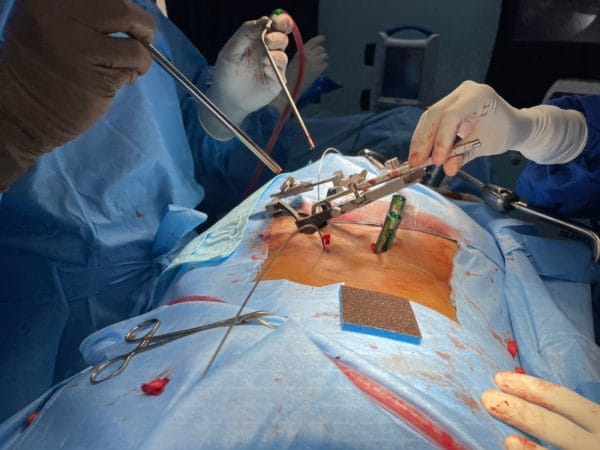
Endoscopic Spine Surgery Types :
Endoscopic Spine Surgery is performed on patients who are diagnosed with the following:
PELD — Percutaneous Endoscopic Lumbar Discectomy:
The most common endoscopic procedure. A small posterolateral or interlaminar approach is used to remove herniated lumbar disc material compressing a nerve root. Ideal for L4-L5 and L5-S1 disc prolapse, sciatica, and radiculopathy.
PECD — Percutaneous Endoscopic Cervical Discectomy:
An endoscopic approach to the cervical (neck) spine. Used to treat cervical disc herniation and cervical radiculopathy causing arm pain or weakness. Avoids the need for a bone fusion in many cases.
UBE — Unilateral Biportal Endoscopy:
A newer technique using two small portals — one for the endoscope camera, one for surgical instruments. Provides excellent visualisation for lumbar canal stenosis decompression and complex disc herniations.
Endoscopic Foraminoplasty:
Enlargement of the nerve exit tunnel (foramen) to relieve chronic nerve compression, often combined with discectomy. Highly effective for foraminal stenosis and recurrent disc herniations.
Endoscopic Lumbar Decompression:
Removal of bone spurs, thickened ligaments, and disc material pressing on the spinal canal. The primary surgical treatment for lumbar spinal stenosis causing claudication or leg weakness.
Conditions Treated by Endoscopic Spine Surgery
Endoscopic Spine Surgery is used to treat a variety of spinal conditions, including:
Lumbar disc herniation / slip disc:
Removal of the herniated disc fragment pressing on the sciatic nerve, eliminating radiating leg pain and numbness.
Sciatica (lumbar radiculopathy):
Decompression of the affected nerve root, providing rapid relief from shooting pain down the leg.
Cervical disc prolapse:
Endoscopic removal of disc material compressing cervical nerve roots, relieving arm pain and tingling.
Lumbar spinal stenosis:
Widening of the narrowed spinal canal using endoscopic decompression, restoring comfortable walking distance.
Facet joint arthropathy:
Endoscopic facet joint debridement and nerve decompression for chronic lower back pain from joint degeneration.
Degenerative disc disease:
Targeted removal of painful disc tissue with minimal disruption to the disc’s structural integrity.
Foraminal stenosis:
Endoscopic foraminoplasty to enlarge the narrowed nerve exit tunnel, relieving chronic radicular pain.
Cervical radiculopathy:
Removal of bone spurs or disc material causing nerve root compression in the neck.
Key Benefits of Endoscopic Spine Surgery
- Minimally Invasive: Smaller incisions result in less muscle and tissue disruption.
- Reduced Recovery Time: Patients can often return to their daily activities much sooner than with traditional surgery.
- Less Pain: Reduced trauma means less postoperative pain and a lower need for pain medications.
- Lower Risk of Complications: The minimal disruption to surrounding structures reduces the risk of infection and blood loss.
Am I a Good Candidate for Endoscopic Spine Surgery?
Not every spinal condition requires surgery, and not every patient who needs surgery is suitable for an endoscopic approach.
Dr. Pushparaj recommends endoscopic spine surgery in Chennai, Tamil Nadu when the following criteria are met:
You have persistent back or neck pain, leg pain, arm pain, or numbness lasting more than 6–12 weeks.
- Conservative treatments — physiotherapy, pain medications, spinal injections have not provided sufficient relief.
- MRI or CT imaging confirms a structural cause (disc herniation, stenosis, bone spur) at a surgically accessible level.
- You are medically fit for surgery under general or spinal anaesthesia.
- You prefer a shorter hospital stay and faster return to daily activities.
- You have a single or two-level spinal problem (multi-level disease may need open surgery or a combined approach).
Patients who are not suitable for endoscopic surgery such as those with severe spinal instability, infection, or complex deformity will be counselled on alternative treatments, including minimally invasive open surgery, fusion procedures, or non-surgical management.
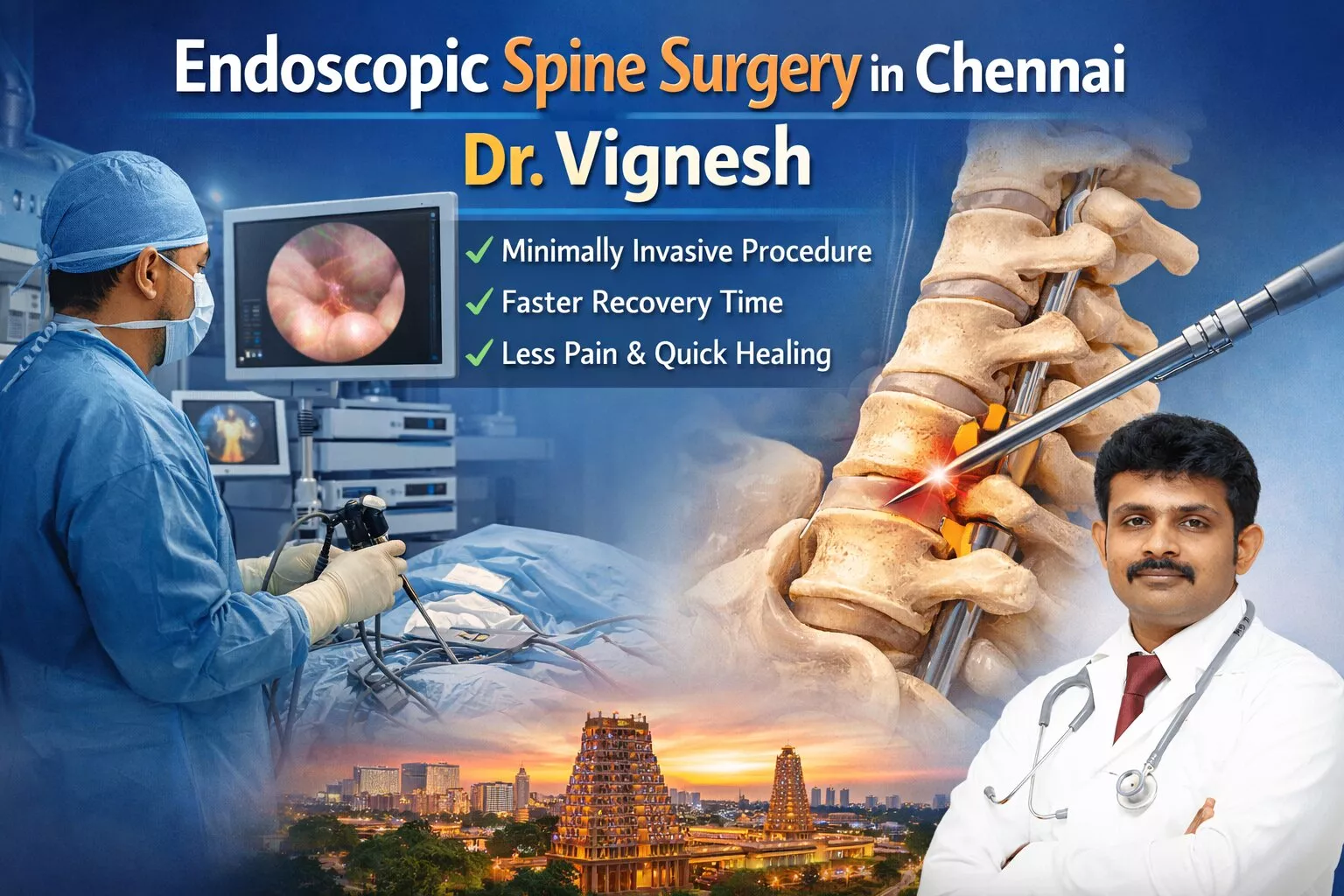
How Is Endoscopic Spine Surgery Performed? (Step-by-Step)
Understanding the procedure helps reduce anxiety and allows patients to prepare effectively.
Here is a typical workflow for an endoscopic lumbar discectomy performed by Dr. Vignesh Pushparaj:
Step 1 — Pre-operative evaluation
A detailed review of your MRI, X-ray, and clinical symptoms to map the exact level and type of pathology. Blood tests and anaesthesia assessment are completed.
Step 2 — Anaesthesia
Most endoscopic procedures are performed under local anaesthesia with sedation, or spinal anaesthesia. General anaesthesia is used when clinically indicated. You remain comfortable throughout.
Step 3 — Positioning & fluoroscopic guidance
You are positioned on a radiolucent table. A C-arm X-ray device confirms the precise entry point on the skin, minimising the incision to under 1 cm.
Step 4 — Endoscope placement
A series of progressively wider dilators are inserted through the incision to create a working channel without cutting the muscle. The endoscope is then advanced to the target level under continuous X-ray control.
Step 5 — Visualisation & treatment
Live HD video from the endoscope camera is displayed on a monitor. Micro-forceps, a laser, or a radiofrequency probe are used through the working channel to remove the herniated disc fragment, decompress the nerve, or clear bone spurs.
Step 6 — Closure & recovery
The incision requires no stitches in most cases — a simple adhesive dressing is applied. You are moved to the recovery room and typically able to walk within a few hours of the procedure.
Step 7 — Discharge & rehabilitation
Most patients are discharged within 24–48 hours. A tailored physiotherapy programme begins within 1–2 weeks to strengthen the surrounding musculature and prevent recurrence.
Benefits of Endoscopic Spine Surgery vs Open Spine Surgery
| Feature | Endoscopic Surgery | Open Surgery |
| Incision size | < 1 cm | 5 – 15 cm |
| Muscle damage | Minimal (dilation only) | Significant (stripping) |
| Blood loss | < 50 ml typically | 100 – 500 ml |
| Hospital stay | 1 – 2 days | 4 – 7 days |
| Return to light activity | 3 – 7 days | 4 – 6 weeks |
| Risk of infection | Very low (< 1%) | Moderate (1 – 3%) |
| Anaesthesia | Local/spinal in most cases | General anaesthesia |
| Scar | Minimal (stitch-free) | Visible linear scar |
Risks and Complications — An Honest Overview
Endoscopic spine surgery has an excellent safety profile, particularly when performed by an experienced surgeon using modern equipment.
However, as with any surgical procedure, risks exist and should be understood before making a decision.
Temporary nerve irritation
Mild numbness, tingling, or weakness at the operated level is common for 2–4 weeks post-op as the nerve recovers from compression.
Infection
The risk is very low (< 1%) due to the small incision and minimal tissue exposure. Antibiotic prophylaxis is routinely administered.
Dural tear (CSF leak)
Rare (< 0.5%). The outer membrane of the spinal cord can occasionally be nicked. This is usually managed conservatively with bed rest.
Incomplete decompression
In a small number of cases, residual disc material or scar tissue may persist, requiring a repeat procedure. Careful pre-operative planning minimises this risk.
Recurrent disc herniation
The lifetime risk of disc re-herniation at the same level is 5–10%, similar to open discectomy. Physiotherapy and posture modification significantly reduce this risk.
Anaesthesia reactions
As with all surgery. All patients are assessed by a qualified anaesthesiologist before the procedure.
Dr. Vignesh Pushparaj discusses each of these risks in detail during the pre-operative consultation and takes individualised precautions based on the patient’s health profile, MRI findings, and comorbidities.
How to Find the Best Endoscopic Spine Surgeon in Chennai ?
With exponential growth in the number of hospitals and doctors now available in Chennai, it can indeed become a daunting task to find the best endoscopic spine surgeon in Chennai, Tamil Nadu.
However, it is important that you may consider some factors before getting the surgery done.
First of all, the spine surgeon in Chennai, India must be highly qualified with the necessary certification and best of medical knowledge.
Secondly, he or she must be proficient with a good amount of experience in conducting endoscopic spine surgery. Also, the concerned must be a specialist in the specific area of your concern.

Why Choose Dr. Vignesh Pushparaj for Endoscopic Spine Surgery in Chennai, Tamil Nadu?
Dr. Vignesh Pushparaj is renowned as one of the best endoscopic spine surgery doctors in Chennai, Tamil Nadu.
His practice is dedicated to advanced spinal care, and he is known for employing advanced technology and modern techniques to achieve the best possible patient outcomes.
Patients benefit from his commitment to precision and personalized care, making him a leading choice for anyone seeking endoscopic spine surgery treatment in Chennai, Tamil Nadu.
Patients from across Tamil Nadu including Chennai, Coimbatore, Madurai, and Trichy — as well as international patients from Singapore, the UAE, and Sri Lanka, seek Dr. Pushparaj’s care specifically for endoscopic spinal procedures.
His commitment to personalised treatment planning means every patient receives a recommendation based on their own MRI findings, lifestyle, and clinical goals not a one-size-fits-all surgical approach.
Recovery After Endoscopic Spine Surgery in Chennai
One of the most significant advantages of endoscopic spine surgery is the speed of recovery.
Most patients are surprised by how quickly they regain mobility.
Here is a general timeline:
Day of surgery Walk short distances within 4–6 hours. Oral pain medications manage any post-operative discomfort. A lightweight dressing covers the incision.
Days 1–2
Discharge from hospital. Most patients can bathe, dress independently, and move around the home.
Week 1–2
Light desk work and sedentary activities can usually resume. Avoid bending, twisting, or lifting objects heavier than 2–3 kg.
Weeks 2–4
Physiotherapy begins. Core strengthening, posture correction, and walking programme are initiated under a physiotherapist’s supervision.
Month 1–2
Return to moderate physical activity, driving, and non-manual work. Most patients report 70–80% improvement in their primary symptom.
Month 3–6
Full return to physical work, sport, and exercise for most patients. A structured back-health programme is recommended for ongoing prevention.
Endoscopic Spine Surgery Cost in Chennai, Tamil Nadu
The cost of endoscopic spine surgery in Chennai varies depending on the type of procedure, the number of spinal levels treated, the hospital or surgical facility used, and any implants required.
|
Procedure |
Approx. Range (INR) |
Notes |
|
PELD (Lumbar discectomy) |
₹1,20,000 – ₹2,50,000 |
Single level; most common procedure |
|
PECD (Cervical discectomy) |
₹1,50,000 – ₹2,80,000 |
Neck disc; varies with hospital |
|
UBE decompression |
₹1,80,000 – ₹3,00,000 |
Two-portal approach; stenosis |
|
Endoscopic foraminoplasty |
₹1,50,000 – ₹2,60,000 |
Combined with discectomy often |
|
Multi-level procedures |
₹2,50,000 – ₹4,50,000 |
Complexity-dependent |
Note:
These are indicative ranges. An accurate cost estimate can only be provided after reviewing your MRI and clinical details.
Many insurance providers including Star Health, New India Assurance, and corporate health policies cover endoscopic spine surgery. Dr. Pushparaj’s team will assist you with insurance pre-authorisation.
Book Your Consultation for Endoscopic Spine Surgery in Chennai
If you are suffering from a herniated disc, spinal stenosis, sciatica, or cervical radiculopathy and want to understand whether minimally invasive endoscopic spine surgery is right for you, the first step is a detailed consultation with Dr. Vignesh Pushparaj.
During your consultation, Dr. Pushparaj will review your MRI or CT scan, assess your neurological status, and give you an honest, evidence-based recommendation whether that is continued conservative care, a spinal injection, or an endoscopic surgical procedure tailored to your diagnosis.
Choosing one of the best endoscopic spine surgery doctors in Chennai, such as Dr. Vignesh Pushparaj, ensures that you receive exceptional care.
With his expertise in endoscopic surgery treatment in Chennai, Tamil Nadu, patients can trust that they are in capable and experienced hands.
For more information or to consult with Dr. Vignesh Pushparaj, reach out today to discover how endoscopic spine surgery can transform your quality of life.
Frequently Asked Questions — Endoscopic Spine Surgery
Q: How is endoscopic spine surgery different from keyhole or laparoscopic spine surgery?
A: These terms are sometimes used interchangeably, but endoscopic spine surgery is distinct from laparoscopic surgery used in abdominal procedures.
Endoscopic spine surgery uses a rigid endoscope inserted directly to the spinal level through a posterolateral or interlaminar route, guided by fluoroscopy, without entering the abdominal cavity.
Keyhole spine surgery is a broader term that can include tubular retractor systems (such as those used in microdiscectomy) and true endoscopic techniques.
Q: Is endoscopic spine surgery painful?
A: Most patients report surprisingly little pain after endoscopic surgery compared to their expectations. Because the muscles are dilated rather than cut, post-operative muscle soreness is minimal.
Oral analgesics manage any discomfort in the first 3–5 days. The pain that brought the patient to surgery — radiating leg pain, arm numbness — typically begins to improve within hours to days of the procedure.
Q: How long does the surgery take?
A: A straightforward single-level endoscopic lumbar discectomy (PELD) takes approximately 45–90 minutes. More complex procedures such as UBE decompression for spinal stenosis or multi-level procedures may take 2–3 hours.
Dr. Pushparaj will give you a personalised estimate after reviewing your MRI.
Q: Can endoscopic spine surgery be done under local anaesthesia?
A: Yes. Many endoscopic lumbar procedures — particularly PELD for disc herniation — can be performed under local anaesthesia with conscious sedation. This is particularly advantageous for elderly patients or those with cardiovascular comorbidities who carry higher risks with general anaesthesia.
Q: What is the success rate of endoscopic spine surgery?
A: Published clinical data for endoscopic discectomy (PELD) report excellent or good outcomes in 85–95% of patients for leg pain relief. Success rates for lumbar stenosis treated by UBE are similarly strong.
Success depends on accurate patient selection, the surgeon’s endoscopic experience, and patient adherence to post-operative physiotherapy.
Q: Is endoscopic spine surgery covered by insurance in Chennai?
A: Many group health insurance and Mediclaim policies do cover endoscopic spine surgery, as it is a recognised surgical procedure. However, coverage depends on your specific policy terms. Dr. Pushparaj’s administrative team will help you check pre-authorisation eligibility with your insurer before surgery.
Q: Will I need a second surgery?
A: Recurrent disc herniation occurs in approximately 5–10% of patients — comparable to open surgery. Adherence to physiotherapy, maintaining a healthy weight, and correct lifting mechanics significantly reduces this risk. In cases of recurrence, repeat endoscopic surgery is often possible.
Q: How do I book a consultation with Dr. Vignesh Pushparaj for endoscopic spine surgery in Chennai?
A: You can reach the Chennai Spine, Scoliosis & Disc Replacement Centre at +91 9150 955 655 (Monday to Saturday, 2 PM – 8 PM) or submit a request via the online appointment form at www.chennaispinecare.com.
Please bring your MRI / CT reports and any previous treatment records to your first consultation.